
B2B discovery is changing rapidly.
Buyers are no longer relying only on Google searches, analyst reports, or vendor websites to find answers. Increasingly, they are turning to AI tools like ChatGPT, Perplexity, and Claude to research industries, evaluate vendors, and discover thought leadership.
That shift is changing what content gets discovered and what gets ignored.
At the same time, AI is compressing the content landscape. As generative platforms summarize and synthesize information at scale, generic content is becoming easier to produce and easier to ignore. The brands gaining visibility are increasingly those producing original insights, not simply repackaging existing ideas.
In this new environment, generic content struggles to stand out. AI systems prioritize content that demonstrates authority, originality, credibility, and relevance. That’s one reason why original research is becoming one of the most valuable assets in modern B2B marketing.
According to The State of B2B Thought Leadership in 2026, 93% of B2B marketers who use research-based content say it is effective at driving engagement and generating leads.
The same study found that 32% of professionals now use GenAI tools to discover thought leadership and vendors, yet many marketers still have not incorporated GenAI platforms into their distribution strategies.
The implication is significant: The companies creating unique insights are increasingly the ones buyers and AI systems discover first.
Why Original Research Performs Better Than Generic Content
There’s no shortage of content in B2B marketing today. The problem is that much of it says the same thing. AI-generated summaries, recycled trends, and surface-level advice have created an environment where many brands sound interchangeable. As Brian Solis of ServiceNow:
“People can tell when content was written by a person who cares versus content that was engineered to rank.”
Original research provides unique insight that AI cannot readily reproduce. Research-backed thought leadership gives brands:
- Unique statistics and data points
- Credible perspectives supported by evidence
- Fresh insights competitors cannot duplicate
- Content that supports both human trust and AI visibility
Research-focused content is especially important as AI systems increasingly evaluate:
- Authority
- Source credibility
- Evidence
- Consistency
- Originality
When a company publishes proprietary data, it becomes a credible source, not just another commentator.
That distinction matters more than ever in an AI-driven discovery environment. Generative AI tools are designed to identify patterns of expertise and surface evidence-backed content from trusted sources. Brands that consistently publish original research create stronger signals of authority for both human buyers and AI systems.
Research also creates a compounding advantage. A single study can fuel blogs, webinars, PR outreach, sales conversations, executive thought leadership, social content, and interactive experiences for months. Over time, this creates a growing body of proprietary insight that strengthens visibility, reinforces credibility, and positions the organization as a trusted voice in its industry.
The strongest thought leadership programs don’t rely on data alone. They combine proprietary research with trusted industry voices. In fact, 74% of marketers who frequently collaborate with influencers report their research-based content as very effective, compared to just 29% of everyone else.
In a marketplace where generic content is becoming easier to produce, differentiated insight is becoming more valuable. Original research helps organizations move beyond simply participating in industry conversations to helping shape them.
For example, a proprietary benchmark report can generate statistics cited in media articles, support webinar discussions, provide sales-enablement proof points, fuel social engagement, and create searchable insights that AI systems can surface in response to buyer questions.
How B2B Companies Use Research to Drive Full-Funnel Marketing
One of the biggest misconceptions about original research is that it only supports top-of-funnel awareness. In reality, the highest-performing organizations use research across the entire customer lifecycle. The research found that 47% of top-performing marketers use thought leadership post-sale, compared to just 28% of others.
One example of research impacting bottom-of-the-funnel purchase decisions is a recent webinar that Ascend2 did with a partner. 22 of the 45 attendees were at the final stage of the purchase decision, so the webinar was an opportunity to demonstrate industry knowledge and build trust to help secure the final purchase.
The B2B Thought Leadership report found that top-performing marketers are significantly more likely to use thought leadership content:
- For awareness
- During evaluation and decision-making
- After the sale, for customer engagement and retention
How marketers use research matters because buyers need different types of confidence at different stages. Research helps:
- Generate awareness with compelling industry insights
- Support consideration with evidence and benchmarks
- Strengthen decision-making with credible validation
- Reinforce customer trust post-sale
In many organizations, one well-designed research study can fuel:
- Executive reports
- Blog articles
- Webinar topics
- PR outreach
- Sales enablement
- Social campaigns
- Interactive content
- Podcasts
- Email nurture campaigns
- Conference presentations
That’s why leading brands increasingly treat research as a strategic content platform, not a one-time campaign asset.
How Experiential Content Extends the Value of Research
The most effective thought leadership programs do more than publish reports. They turn research into experiences that audiences actively engage with.
There is a growing gap between what marketers know works and what they consistently execute. While 78% of B2B marketers say interactive and experiential content increases repeat engagement, only 33% regularly build it into their campaigns.
That gap creates a major opportunity.
Research studies can fuel a wide range of experiential content formats, including:
- Interactive benchmark tools
- Data visualizations
- Webinars and virtual panels
- ROI calculators and assessments
- Video explainers
- Industry roundtables
- Interactive content hubs
These formats help transform static information into more memorable and engaging experiences. They also encourage audiences to spend more time interacting with the brand, increasing the likelihood of repeat engagement.
Experiential content also performs well in today’s multi-channel discovery environment. Video clips, webinars, interactive tools, and visual data stories are more easily repurposed across social media, email campaigns, PR outreach, sales conversations, and AI-search-friendly content ecosystems.
In many cases, research becomes less of a standalone asset and more of a content engine that continuously generates new conversations, experiences, and opportunities for discovery.
What Makes Thought Leadership Credible in the AI Era?
As AI-generated content becomes more common, credibility becomes more valuable.
97% of B2B marketers believe thought leadership is critical to full-funnel success. But not all thought leadership builds trust equally.
Today’s buyers are looking for:
- Evidence over opinions
- Expertise over promotion
- Insight over volume
Research-backed content performs well because it demonstrates investment, rigor, and expertise. It signals that the organization invested in understanding the market rather than simply reacting to it. It signals that a company:
- Understands its market
- Listens to customers
- Tracks industry trends
- Has access to meaningful data
- Can provide informed guidance
This is one reason why research-based thought leadership consistently outperforms purely promotional content in both engagement and trust metrics.
As Cindy Anderson of IBM noted:
“Without that foundation, you’re just publishing opinion.”
How AI Search Is Changing Content Discovery
Traditional SEO focused heavily on ranking pages. AI discovery changes the model.
Unlike traditional search engines, which primarily rank pages, AI systems synthesize answers from multiple sources. This shifts the emphasis from ranking alone to becoming a source AI systems repeatedly recognize and reference. Brands publishing original research create stronger “citation signals” because they contribute unique information to the ecosystem rather than repeating existing commentary.
Today, buyers increasingly ask AI systems direct questions such as:
- What companies specialize in B2B thought leadership research?
- How do you build credible thought leadership?
- What content performs best in AI search?
- How do companies use original research for demand generation?
AI tools then synthesize answers from trusted sources across the web. That means brands must optimize not just for keywords, but for answerability. The companies most likely to be surfaced are those consistently publishing:
- Original insights
- Structured expertise
- Clear explanations
- Credible data
- High-authority content
AI favors companies that act like educators and industry authorities. That aligns directly with the findings in The State of B2B Thought Leadership, which emphasizes becoming the “best answer” wherever buyers search.
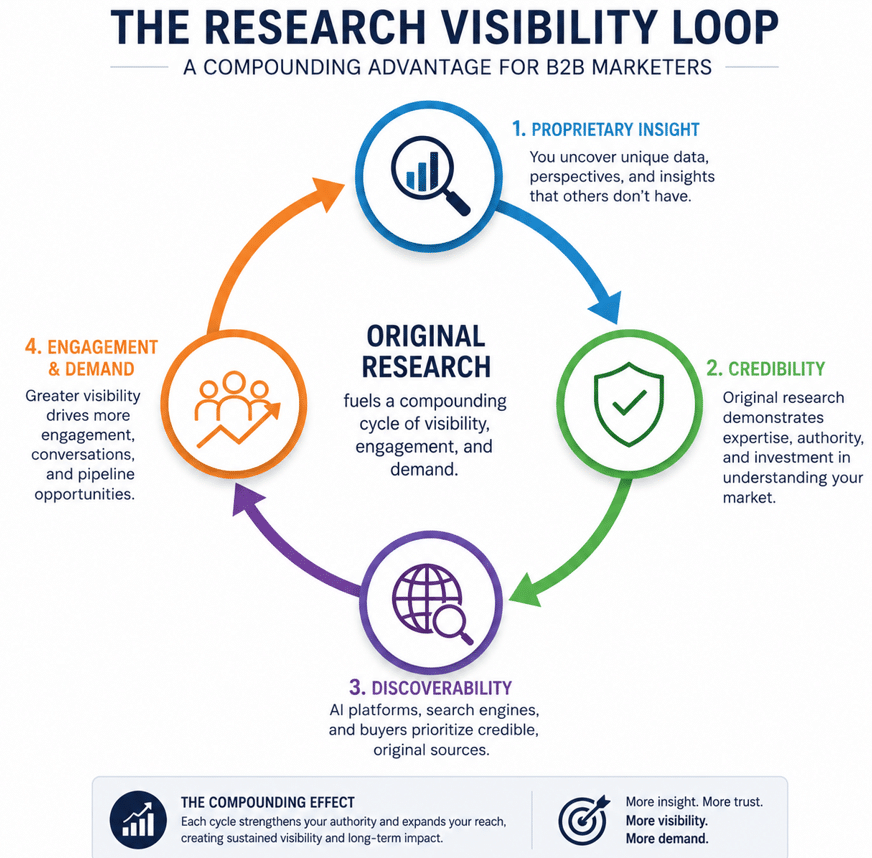
Original research creates a compounding visibility loop: proprietary insights build credibility, credibility strengthens discoverability, and discoverability drives more engagement and demand.
What High-Performing B2B Marketers Are Doing Differently
Successful companies no longer build thought leadership programs around isolated campaigns. Instead, they are building integrated “answer engines.”
The research identified six key drivers behind high-performing thought leadership strategies:
- Data-informed strategy
- Integrated content execution
- Trust systems
- Experiential content
- Multi-channel discovery
- Full-funnel analytics
Top-performing organizations are:
- Using customer insights to shape research topics
- Repurposing research across channels
- Combining influencer expertise with proprietary data
- Expanding distribution beyond their website
- Measuring research impact across the funnel
Importantly, many top-performing organizations are already adapting to AI-driven discovery behavior by expanding visibility across emerging channels and treating AI discovery as part of their thought leadership strategy.
High-performing marketers are also more likely to:
- Extend research across multiple quarters instead of one-time launches
- Repurpose findings into multiple content formats
- Align research topics with customer pain points and buying decisions (problem/solution)
- Combine quantitative data with an executive perspective
- Build integrated distribution strategies across PR, influencer, social, email, webinar, and sales channels
Why Original Research Is Becoming a Competitive Advantage
As AI lowers the cost of producing content, differentiation increasingly comes from owning unique insight. Proprietary research becomes difficult for competitors to replicate because the value lies not just in the content itself but also in the underlying data, audience access, methodology, and interpretation.
Original research creates:
- Defensible expertise
- Media-worthy insights
- Stronger brand authority
- Better engagement
- Better AI discoverability
- Longer content shelf life
In many ways, original research is becoming one of the few scalable means of creating truly differentiated B2B content.
The Opportunity Ahead
The gap is widening between brands that produce interchangeable content and those that have become trusted industry resources. The companies that win in the next era of B2B marketing will not simply publish more content; they will publish:
- Better evidence
- Better insights
- Better answers
That’s why original research is increasingly becoming the foundation of modern thought leadership strategies. Not just for SEO. Not just for PR. But for visibility, credibility, trust, and discoverability in an AI-driven world.
As AI reshapes how buyers discover and evaluate expertise, original research is becoming more than a marketing asset. It is becoming the foundation of visibility, authority, and trust in the modern B2B marketplace.
About the Research
The insights and statistics featured throughout this article are drawn from The State of B2B Thought Leadership in 2026, a research study conducted by Ascend2 in partnership with TopRank Marketing.
The study surveyed 797 senior-level B2B marketers across the United States and United Kingdom and explored how organizations are using original research, thought leadership, influencer collaboration, and multi-channel content strategies to build visibility, trust, engagement, and full-funnel impact in an AI-driven marketplace.
The Ascend2 Research Methodology
In a marketplace flooded with generic content, original research creates differentiation.
Ascend2 combines rigorous market research with strategic storytelling to help B2B brands transform proprietary data into trusted industry insights and impactful thought leadership content.
Our methodology goes beyond collecting survey responses. We design custom research programs that uncover meaningful trends, surface credible evidence, and answer the questions buyers are actively asking. By combining statistically credible research with insight-driven narratives, Ascend2 helps organizations create content strategies that support visibility, engagement, trust, and AI-era discoverability.
From audience targeting and survey design to data analysis, report development, and multi-channel content activation, Ascend2 delivers end-to-end research programs designed to support thought leadership, demand generation, PR, sales enablement, customer engagement, and executive visibility.
Research studies are developed not simply as standalone reports, but as scalable content platforms that can fuel blogs, webinars, media outreach, social campaigns, conference presentations, sales conversations, interactive experiences, and ongoing nurture programs.
This combination of methodological rigor and strategic activation helps organizations create research-driven content engines that continue to deliver value long after launch, while strengthening authority and trust across the buyer journey.
Organizations that partner with Ascend2 to conduct research studies include Intuit Mailchimp, Workiva, Canto, Unbounce, Constant Contact, Akona, Antertiad, Cleverbridge, Collibra, Growthloop, Revsure, Nexla, Aptitude8, Arbinger, Porch Media Group, TopRank Marketing, Intentsify, Act-On Software, Conga, and more.