
B2B buyers are searching differently. They vet more sources, rely on peers and trusted experts, and increasingly turn to answer engines like ChatGPT to validate what vendors say. In this environment, traditional marketing messages no longer earn trust. Authority wins, and original research is becoming the fastest path to it.
The Ascend2 team is excited to release a new study in partnership with TopRank Marketing. For this research report, we surveyed 797 senior-level marketing leaders from B2B companies located in the United States and the U.K. to answer this question:
What strategies are you adopting to deliver thought leadership that drives measurable business outcomes?
To answer this question, we looked at:
- How do you build trust with your target audience?
- How do you differentiate yourself from others?
- What is the impact of AI on thought-leadership content?
- What is working and not working in thought leadership strategies?
- Plus: challenges, content formats, channels, and more.
The research found overwhelming support for thought leadership built on original research (93% find it effective). But creating a solid foundation of original research is only the beginning. On that foundation, you need to develop a strategy that amplifies your research content through industry influencers, a multi-channel approach, and full-funnel analytics.
The report, The Answer Engine of B2B Thought Leadership in 2026, is filled with research findings (use the data to justify your 2026 budget and plans) and a practical framework for applying them to your marketing program. At Asend2, we call this Research in Action.
Get your copy of the 31-page Answer Engine report and see how the highest-performing B2B brands are building trust, visibility, and pipeline in 2026.
First, here are a few of the key findings from the research study:
- 97% of B2B marketers say thought leadership is critical to full-funnel success.
- 93% of B2B marketers using original research-based content feel it is effective at driving engagement and generating leads.
- 74% of those who frequently use influencers report that their research content is very effective, compared to 29% of all others.
- 44% more brands producing very effective research-based content say their marketing significantly drives revenue.
“Thought leadership without original research is just opinion. Research gives your perspective weight.” Cindy Anderson, CMO, IBM Institute for Business Value
This study uses the research to identify six core components that separate high-performing thought leadership programs from underperforming ones. We refer to this framework as the Answer Engine, a repeatable system for earning trust, visibility, and revenue impact.
Here is a brief overview of the framework you will find in Answer Engine.
1. Data-Informed Strategy
Top-performing marketers start with real customer insight, not assumptions. Customer feedback (53%), CRM data (44%), marketing trend analysis (44%), and brand strategy (40%) are the top sources used to determine your research topic. When choosing a research topic, make sure it is of interest to your ideal customer profile (ICP), valuable to your ICP, and aligned with your business strategy (or that it influences the direction of your plan).

Remember, for research to be valuable, it must be relevant to your target audience. You are not creating content volume; you are creating content that builds trust and positions you as a thought leader (influence).
Tip: Before you publish another campaign, start by listening: research what your buyers are actually questioning and deciding. Strategy begins with clarity.
2. Integrated Strategy
Original research becomes the center of a content flywheel. One study fuels a continuous stream of derivative content across formats and channels, allowing every piece to reinforce the next. The more the flywheel spins, the more efficient and effective your content program becomes, without increasing your workload.
What are some of the challenges limiting the ability to drive full-funnel marketing success? Limited visibility into funnel performance (34%), too few channels (33%), and generating top-of-funnel leads (31%) are the top challenges.

Original research fuels the entire content ecosystem. With an integrated strategy, every piece of content becomes more intentional, more connected, and better able to deliver credibility and trust across the entire buying cycle.
Tip: Treat research as your core asset, not a one-off deliverable. Build a content flywheel where each piece reinforces the next and increases momentum over time.
3. Trust System
Buyers want credible information they can trust. High-quality research and influencer content build that trust.
97% of B2B marketers agree that thought leadership is critical to full-funnel success, and 35% say original research is significantly more valuable than AI-generated content for building trust and authority; another 32% say it is more impactful overall.
Building a trust system doesn’t happen by accident; it requires a system. Authority is not a one-hit wonder. Trust starts with proof, grows through repetition, and compounds into authority over time.
For example, top marketers:
- Publish consistently to maintain presence.
- Collaborate with credible external voices to expand authority.
- Lead with education to earn trust before asking for action.
The data behind the trust system: 72% of B2B marketers who frequently collaborate with influencers report that their research content is very effective, compared with just 29% of the rest.
Tip: Earn trust through consistency and credibility. Show up regularly with data-backed insight and partner with respected industry voices to validate your point of view.
4. Experiential Content
Experiential research data, combined with an exceptional content experience, is a powerful combination.
What content formats are most impactful? Tops on the list are video content (48%), live/virtual events (48%), and interactive experiences (48%).
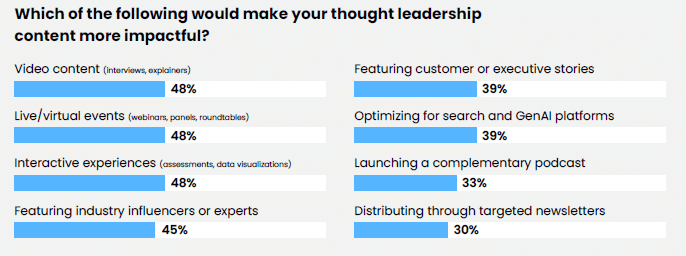
High-performing brands bring research to life through interactive visualizations, data storytelling videos, and roundtable discussions.
78% of B2B marketers say interactive and experiential content increases repeat engagement, yet only one-third regularly build it into their campaigns. So what should you do? Make your content memorable, and make the process repeatable.
Tip: Don’t just share the data, stage it. Turn research into interactive, visual, or live experiences that invite your audience to explore rather than just read.
5. Multi-Channel Discovery
Buyers move across channels to validate decisions, and they expect your content to meet them wherever they look. For example, 32% of buyers report using GenAI tools (ChatGPT, Perplexity, Claude, etc.) to discover thought leadership—even though most marketers haven’t included these platforms in their distribution strategies.
The top channels for distributing thought leadership are LinkedIn (54%), in-person events (54%), YouTube/video (51%), and GenAI tools (32%).
Also, are your channels aligned with where your prospects are consuming thought leadership content?
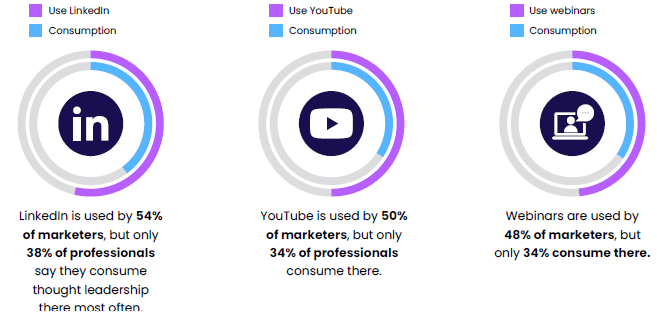
Remember, being findable is being credible. Multi-channel discovery ensures that wherever buyers turn, your brand is part of the conversation.
Tip: Meet buyers where they already search. Optimize your research content for the channels and answer engines that your audience uses to validate decisions.
6. Full-Funnel Analytics
Authority must be measured, not just assumed. The best teams connect:
Awareness → Engagement → Conversion → Revenue → Post-sale expansion
Unfortunately, 41% of B2B marketers cite difficulty measuring performance as the top cause of underperforming content.
On a positive note, high ROI marketers are more likely to use thought leadership across all funnel stages:

Full-funnel analytics enables you to analyze performance, make adjustments, and invest where it has the most significant impact.
Tip: Look beyond clicks. Track how research influences awareness, engagement, pipeline, and expansion to decide where to double down (and what to stop doing).
Why This Matters for 2026 Planning
The brands that are accelerating growth are doing two things differently:
- They create fewer, more strategic content assets.
A single research study can fuel:
| Format | Outcome |
| Landing pages & hero reports | Lead acquisition |
| Webinars & virtual events | Engagement & pipeline |
| Sales email sequences | Conversion acceleration |
| Executive social content | Trust building |
| PR placements | Visibility & authority |
| Partner/influencer collaborations | Audience expansion |
- They treat research as ongoing, not episodic.
A one-time report creates attention. A recurring research program creates ownership and a platform.
Platforms build:
- Reputation
- Market positioning
- Consistency of narrative
- Category ownership
Brands that publish research annually or quarterly become the default authority in their space. At Ascend2, the majority of our clients conduct annual studies that position them as the thought leaders on that topic.
The Takeaway for Marketing Leaders
If your 2026 content and demand strategy does not include original research, you will compete against:
- AI-generated similarity
- Increasing buyer skepticism
- Rising noise in every channel
If you do incorporate original research, you gain:
- Thought leadership authority
- Higher credibility with decision-makers
- More effective sales enablement narratives
- More discoverable and defensible search presence
- A connected content ecosystem that makes every asset perform harder
Learn how to use original research at your company in 2026. Schedule a Research Consultation with the Ascend2 team.
Get Your Free Answer Engine Report
This summary only scratches the surface.
The full report includes:
- The complete Answer Engine framework
- Insights from 797 senior-level B2B marketers
- Benchmarks for high-performing vs. average content programs
- Guidance on where to invest, and where to stop